AI-directed software development.
You bring the problem. We specify it, build it, test it and review it through a pipeline that catches its own mistakes — then hand you a repository you could give to anyone. Web applications, robotics, internal systems: the method does not change with the domain.
What we build
The method does not change with the domain. That is rather the point of it.
-
A 3D robotics tool
RoboStudio: a browser-based robotics studio — model, simulate and export a build-ready ROS 2 package. Live 3D, CAD import, full physics simulation on real compute, and a package a roboticist can actually run.
-
An operations system
A workshop management platform in daily operational use — scheduling, job tracking, permissions, audit and reporting for a business with no engineering team of its own.
-
The pipeline itself
The delivery platform described below, which plans, implements, validates and reviews every change on every project we take. We built it the way we build client work.
We are not limited by which specialists we happen to employ, which is the practical difference this way of working makes. If we take your project on it is because the method suits the problem, and we will say so plainly when it does not.
How the work runs
The same route for every change, on every project.
-
A ticket, with acceptance criteria
Work is specified before it is built. What "done" means is written down first, and it is what the reviewer later checks against.
-
A plan, committed to your repository
Before any code, the change is broken into tasks and that plan lands as the first commit on the branch. It sits in your git history permanently, next to the code it produced.
-
Implementation in isolation
Every ticket gets its own branch and its own checkout. Two pieces of work running at once cannot touch each other's files, and nothing has a route to your production branch.
-
Validation we run ourselves
After every pass we run your project's own commands — bootstrap, lint, typecheck, test, build — and store the exit code. An agent's account of whether the tests passed is not evidence.
-
An independent review panel
Several agents read the same commit, each through exactly one lens: correctness, cascading impact, plan faithfulness, and whatever else the change warrants from a catalogue of twenty. No seat sees what the others found. Any one of them can send the work back.
-
A person at both ends
Someone approves the plan before an agent starts, and someone promotes every release. The pipeline is autonomous in the middle and supervised at the edges.
✦ Every change. Every project.
Evidence, not adjectives
Measured on our own delivery pipeline, July 2026.
That last figure is the one worth asking anyone about. A one-in-three rejection rate is quality control working. A reviewer that approves everything is decoration.
RoboStudio
Our own product, built this way.
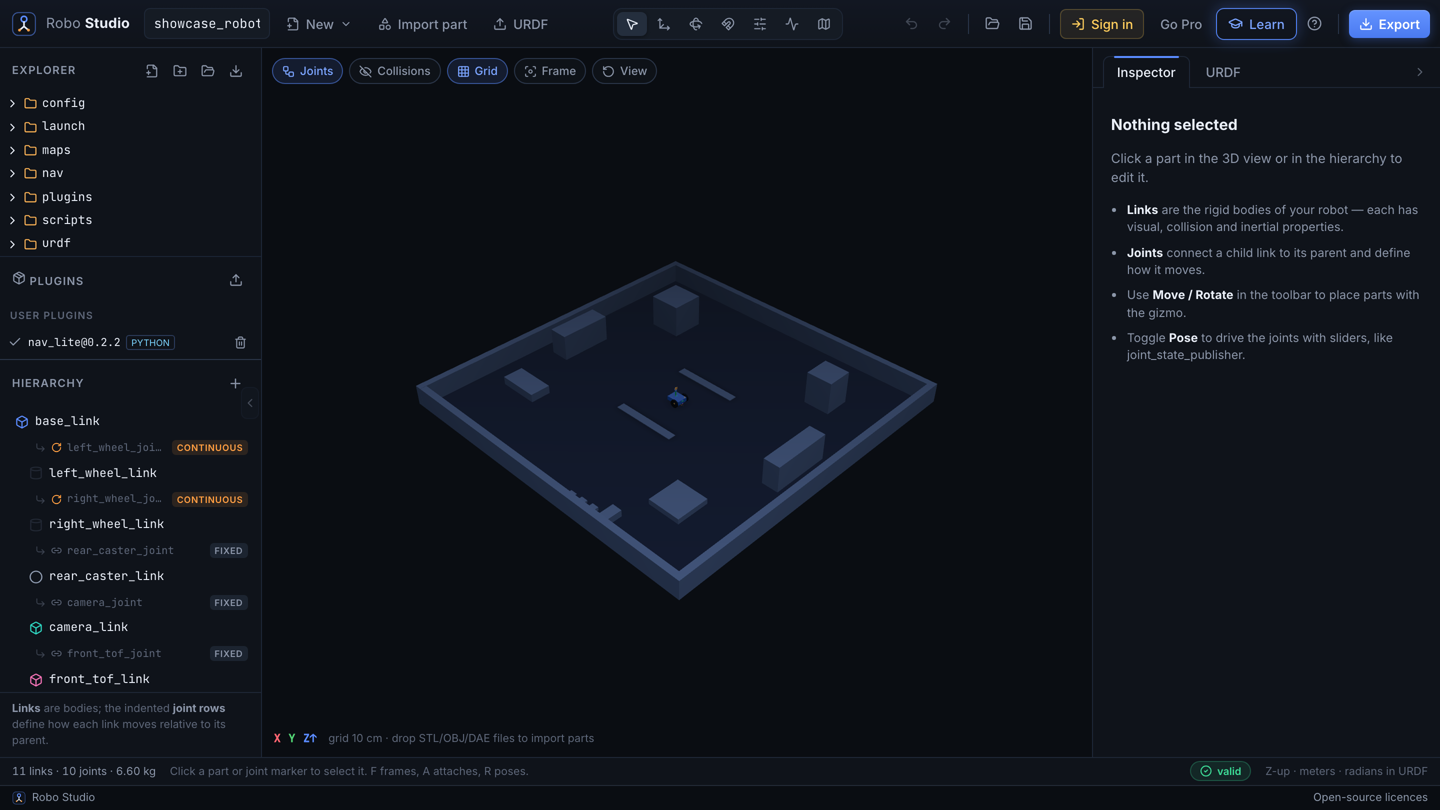
A browser-based studio for building and simulating robot models. Assemble links and joints in a live 3D view, test the articulation with sliders, drag in CAD parts, run the physics on real compute, then export either a plain URDF file or a complete build-ready ROS 2 package with launch file, RViz config and meshes included.
Writing URDF by hand is miserable work, and that is only where RoboStudio starts — it is a full ROS simulation studio, with 44 of its tickets planned, implemented, validated, reviewed and merged through the pipeline described above.
- 44 tickets through the pipeline
- ROS 2 package export
- Full physics simulation on real compute
- STL, OBJ, DAE CAD import
What you keep
The record lives in your repository, not in a tool of ours you have to trust.
The plan for every change, the pull request it became, and the review findings that sent it back — all of it in your own git history, next to the code. Stop working with us tomorrow and the next team can read why every decision was taken without asking anybody.
We are taking on new projects.
Tell us what you are trying to build and we will tell you honestly whether this way of working suits it.
Start a projectThe pipeline is warm.
Tell us what you need
What are you trying to build, and what is making it hard? A few sentences is plenty to start.